01 September 2026 · 8 min
Automation: process before prompt
Where AI and automation genuinely save time — and why an unclear workflow only becomes chaotic faster with a new tool.



Automation amplifies what already exists
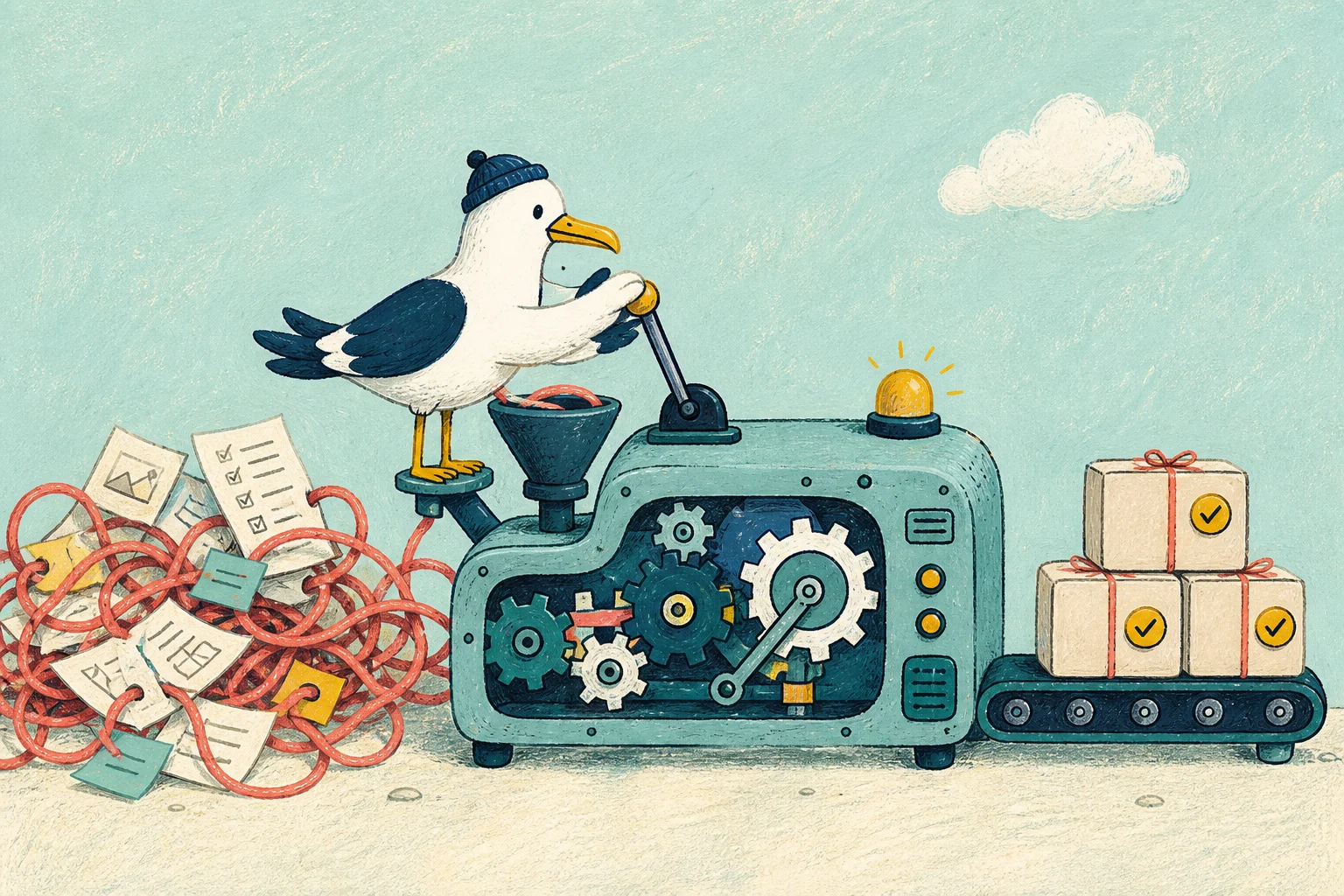
A manual process may be slow and still work. Once automated, its good and bad characteristics run more frequently, more quickly and with less visibility.
Successful automation projects therefore do not begin with a tool or a prompt. They begin with an honest view of the workflow. What triggers it? Which data is required? Where is a decision made? Who checks the result? What happens when something is missing?
Without those answers, automation becomes a chain of exceptions that nobody can explain.
Find good first candidates
Not every task should be automated. The strongest candidates happen frequently, have clear inputs and follow understandable rules.
Typical examples include structuring inbound enquiries, enriching CRM data, recurring reports, release checks, content preparation or sorting internal documents. Rare decisions with high risk, unclear ownership or heavy human context are usually poor starting points.
A simple assessment helps. How much time does the process consume each month? How stable are its rules? What would a wrong result cost? High volume and clear rules make a much better first project.
Use AI where rules are not enough
Traditional automation is strong when conditions are explicit: when A happens, execute B. AI adds value where language, images or unstructured information have to be understood.
A model can summarise an enquiry, detect topics, prepare a draft or classify documents. It should not automatically trigger every downstream action. Customer messages, pricing, permissions and publication require clear boundaries and often human approval.
A robust pattern is simple: the machine prepares, the rules validate and a person decides at critical points.
Visibility matters more than magic
Good automation exposes its state. Owners should be able to see which step is running, which data was used and why an item stopped.
That requires logs, understandable errors, retry rules and a manual route for exceptions. If a system only works while nobody needs to inspect it, it is not dependable infrastructure yet.
Costs and runtimes should be visible too. A workflow that calls several external services and large models for every small event may be technically elegant and economically pointless.
Start small and measure real impact
The best first workflow is rarely the most spectacular. It solves one clearly bounded recurring task, has an accountable owner and produces a measurable result.
Useful measures include processing time saved, fewer transfer errors, shorter response time or a higher proportion of fully prepared cases. After a few weeks, the team can decide whether the workflow should expand, change or stop.
Automation is organisation design
Technology connects steps. It does not decide which workflow makes sense, which exception deserves attention or who owns the outcome.
Teams that clarify the process before choosing the tool build fewer impressive demos — and far more systems that reliably remove work from everyday operations.